
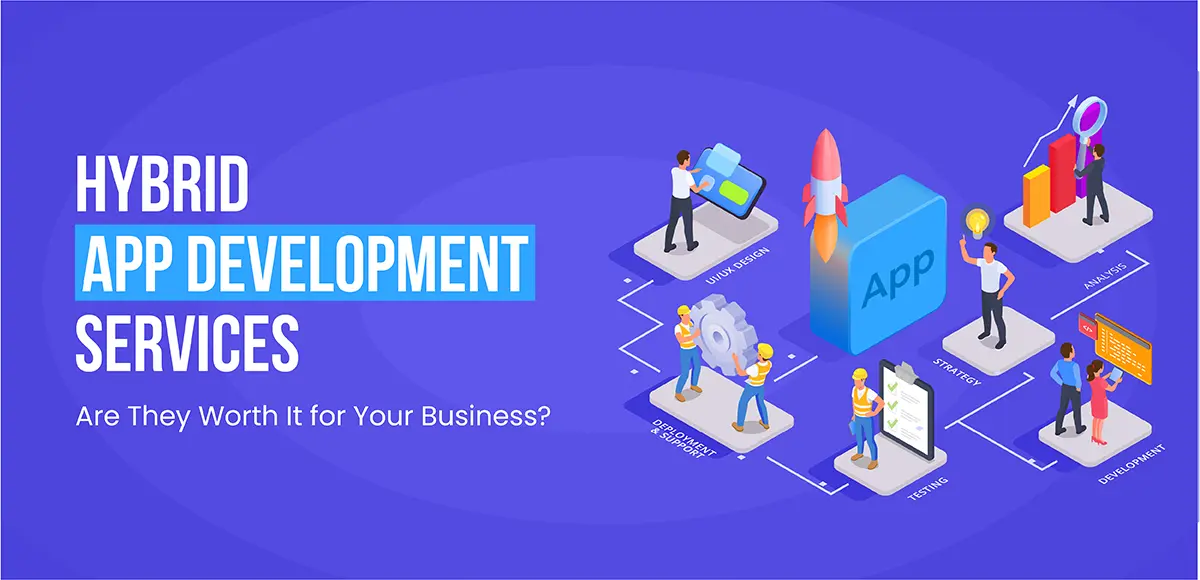
Hybrid App Development Services Are They Worth It for Your Business?
Hybrid app development is the most logical path for any business that wants to lead the market. Hybrid app development services have saved many businesses from ending up with an app that felt like a “website in a box,” complete with laggy scrolling and buttons that didn’t quite fit the screen. It gets you unstruck from the traditional coding grind by giving one codebase that works everywhere, allowing your team to focus on improving the app instead of repeating the same coding task. Developers write the app once and deploy it across platforms like Android and iOS, instead of building and maintaining two separate native apps.
Is Hybrid App Development Better Than Native?
When you decide to build a mobile app, you usually hit a fork on the road. Do you build two separate apps (one for iPhones and one for Androids), or do you build one app that works on both?
Years ago, Hybrid apps felt a bit “laggy.” Fortunately, but now Flutter and React Native have solved this problem. Instagram, Uber Eats, and Pinterest use Hybrid technology for parts of their systems. This proves its capabilities of handling high-traffic applications because if those giants trust Hybrid to handle millions of users without crashing, it’s definitely powerful enough for your business.
The strategic advantage hybrid app offers include:
- Faster Launch: You can get your app into the App Store and Google Play Store much quicker. In a world where trends change every week, being first matters more than ever.
- Update Once: When you want to change a feature or fix a bug, you only have to do it once. With Native apps, you might fix a bug on Android, but your iPhone users are stuck with it for another two weeks while that team catches up.
- Easier Maintenance: Keeping an app running smoothly is a long-term job. Having only one “brain” (codebase) to look after makes your life way much more convenient and your monthly bills much lower.
What are the Best Frameworks for Hybrid App Development
There is no single “best” framework for every project, but some frameworks consistently stand out depending on business needs. To make the most hybrid app development, the choice of right framework is key to determining exceptional performance. These are some frameworks for hybrid app development that are changing the way businesses create mobile apps.
Flutter
Flutter has emerged as one of the most powerful hybrid app frameworks in recent years. Backed by Google, Flutter allows developers to build apps for Android and iOS using a single codebase written in Dart. What sets Flutter apart is its UI rendering approach. Instead of relying heavily on native components, Flutter uses its own rendering engine, which gives developers more control over design and performance. This makes Flutter ideal for businesses that want visually rich, highly customized interfaces without building separate native apps. Flutter is especially popular for startups, MVPs, and design-heavy applications. Companies like Alibaba and Hamilton Musical have used Flutter to build scalable and attractive apps, proving its reliability at scale.
React Native
React Native is another leading framework that continues to dominate hybrid app development. Created by Facebook, React Native allows developers to build real native-like apps using JavaScript and React. Unlike traditional hybrid approaches, React Native uses native UI components, which helps improve performance and user experience. For businesses already using React for web development, React Native offers a natural transition into mobile apps. It is widely adopted, well-supported by the community, and suitable for both startups and large enterprises. React Native is a strong choice when performance matters and when businesses want apps that feel close to native without doubling development effort.
Ionic
Ionic is a well-established hybrid framework that focuses on web technologies. Built on top of HTML, CSS, and JavaScript, Ionic works well with Angular, React, and Vue. Many developers can start building mobile apps without needing to learn a completely new language. Ionic also works smoothly with popular front‑end libraries and frameworks for teams to reuse skills and code across web and mobile projects. Its biggest strength is its rich library of UI components. These ready‑made elements make it easy to build interfaces that look consistent across devices. Now because the interface components are pre‑designed and tested, developers spend less time on styling and more time on features. For businesses that want a strong web presence as well as mobile reach, Ionic offers a way to build both without starting from scratch twice.
Xamarin/.NET MAUI
Xamarin, now evolving into .NET MAUI, is a hybrid framework built on the C# and .NET, making it a strong choice for enterprises already invested in Microsoft technologies. Developers can share business logic across platforms using a single language while still accessing native device features, which is especially useful for enterprise apps that require reliability, maintainability, and strong native integration. Microsoft’s backing adds extra confidence for long-term support and stability. Conversely, the main trade-offs are that its community is smaller compared with Flutter or React Native, and the system is still gradually shifting as MAUI becomes more established.
NativeScript
NativeScript is a hybrid app framework that stands out because it lets developers use familiar languages like JavaScript or TypeScript to build apps that run with real native user interfaces and direct access to device features. It doesn’t rely on WebViews and bridges, and it can use native UI components and hardware features without as many workarounds or plugins. However, it isn’t as widely chosen today as React Native or Flutter because its community and number of ready‑made plugins and resources are smaller, which can make finding help, libraries, or solutions to uncommon problems harder. As a result, teams sometimes prefer frameworks with larger support networks and faster momentum, even though NativeScript still offers a valid and capable technical approach for building cross‑platform mobile apps.
Wrapping up
Hybrid mobile app development is clearly having a moment. It blends the core strengths of native and web apps, giving businesses a flexible way to build once and run across platforms. Now before you jump into hybrid app development services, you must understand when hybrid apps fall short.
Hybrid app development makes sense when:
- You’re okay trading a bit of polish for speed and reach. Hybrid apps depend heavily on HTML5, which can limit the smoothness of the user experience.
- Your app doesn’t rely on deep native interactions or ultra-custom UI behavior. Native apps still win when familiarity and precision matter most.
- High-performance graphics, intense animations, or gaming-level responsiveness aren’t critical. Hybrid apps aren’t built for graphics-heavy demands.
Once your requirements and design are clear, the right development partner can take it from there.
Leave a Comment